
Remembering the Dance Benefactor Dianne Vapnek
A tribute

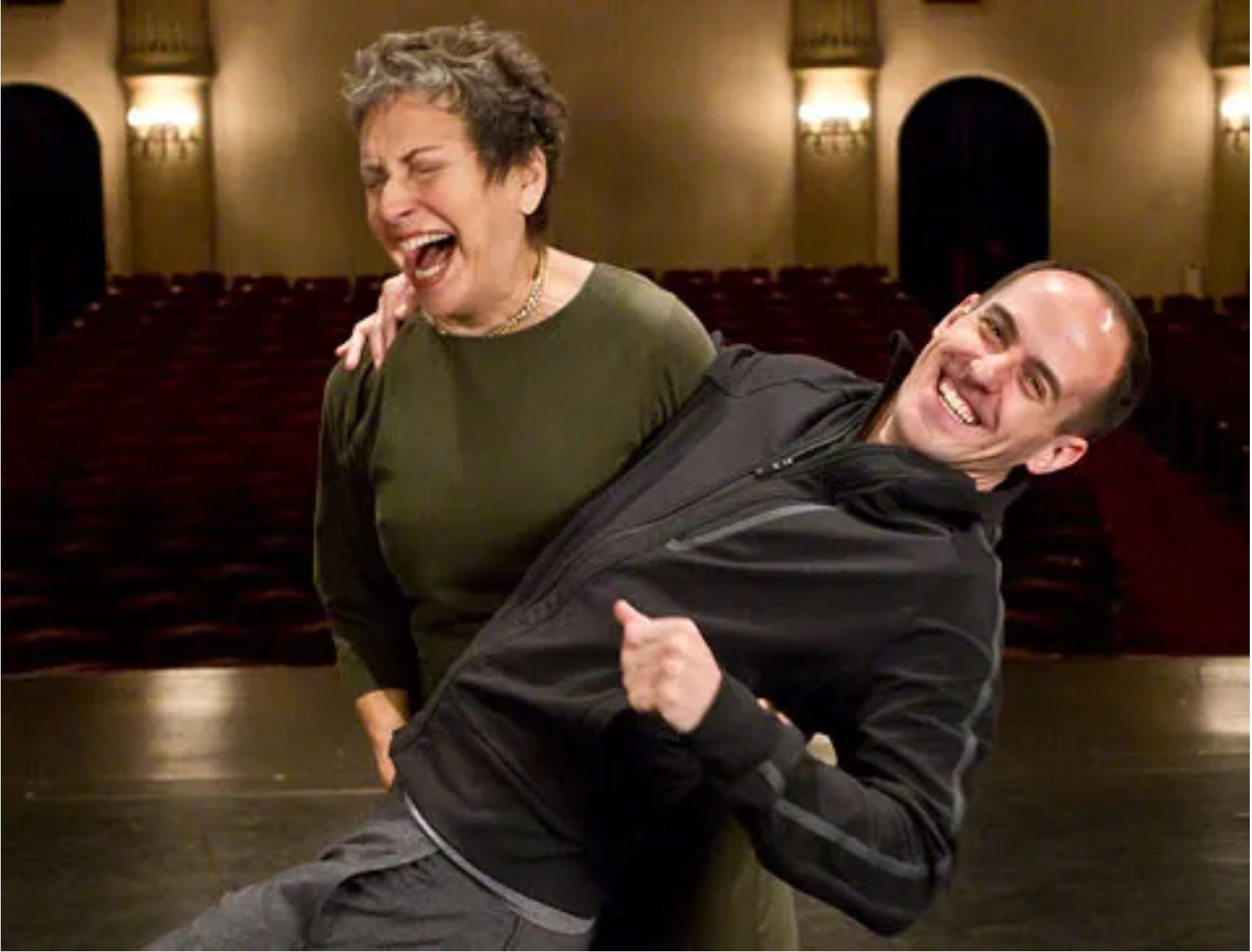
DANCEworks residency founder Dianne Vapnek with choreographer Brian Brooks inside Santa Barbara’s Lobero Theater. DANCEworks residencies supported dances created by, among others, Aszure Barton, Mark Dendy, and Larry Keigwin. Photo by David Bazemore.
Dianne Vapnek created DANCEworks, a residency program that provided dance artists with unparalleled working conditions, including a full month of creative time onstage in Santa Barbara’s Lobero Theater. Dianne died on June 26, 2026. She was a great friend to the choreographers she supported—including Doug Varone, Aszure Barton, Doug Elkins, Mark Dendy, Kate Weare, Adam Barruch, Margaret Jenkins, and Larry Keigwin—and she was a model of life well lived. I spoke with some of the artists she encouraged both materially and spiritually, and wrote this tribute, “Five Remembrances of a Benefactor,” for Fjord Review:
The way Margaret Jenkins tells it, Dianne came to her dance company’s studios in 1973, asking to take class. Dianne was then living in a one-bedroom apartment near San Francisco’s Mission District with her scientist husband and three young kids. She had loved dance since her childhood in Massachusetts, attending Jacob’s Pillow. She took class with Margy for about a year, until her husband got a job at the University of Georgia. Dianne and Margy lost touch. Then in the early 90’s, Margy got a call from the dance department at the University of California at Santa Barbara, asking if she would come teach guest workshops there, and she knew such opportunities don’t fall from the sky. Margy asked the department how this had all come about. It turned out a woman named Dianne Vapnek had recently moved to Santa Barbara, and she had called the university and said that if they would bring Margy to teach, she would pay for it.
The way Margy tells it, “Frankly, at that moment I barely remembered who Dianne was.” But then the memory came back. “And I thought, ‘God, I wonder how—when I knew her, she was so poor, right?’”
Soon, Margy learned the basic story over dinner with the Vapnek family: From the University of Georgia, Dianne’s husband Dan had been one of the first scientists to join a new biotech research firm. He had helped discover an extraordinary drug that helped people in chemotherapy. An initial public stock offering had reaped many millions.
Dianne and Margy stayed in touch, and a few years later Dianne said, “I love dance, and I really want to do something with it. What do you think the field needs?”
Margy’s advice: “The greatest gift an artist can get is free time to create work, unencumbered by expectations.” Dianne wanted to understand everything from the artist’s point of view: what kind of facilities would a choreographer need? How much should a choreographer be paid?
This is the story Margaret Jenkins told me after she texted to let me know Dianne had died.
As we spoke, I stared at a picture: Dianne on the stage of Santa Barbara’s Lobero Theater, rows of red velvet seats behind, her short hair that always seemed tousled by the force of her wild energy lightly greying. In this publicity photo, Dianne has her blue eyes closed and her big mouth wide open because the choreographer Brian Brooks has thrown himself into her arms, mugging for the camera. He’s pretending she’s his dance partner—a pose that could not be more metaphorically apt.
I looked at the photo and I told Margy, “I hear her laugh.” That’s what all the dance artists I talked with later said, too.
Later, other choreographers would send photos: Dianne with Doug Varone (the first choreographer Dianne brought to Santa Barbara and commissioned, back in 1997); Dianne with Aszure Barton, Doug Elkins, Mark Dendy, Larry Keigwin. For Summerdance, the festival she presented from 1997 until 2006, Dianne hosted Tamango and his Urban Tap company; later, for one of the DanceWorks residencies, a program she created in 2009, she brought out the venerated Canadian choreographer Margie Gillis. But Dianne’s passion was for a distinct flavor of American contemporary dance that fit her unmistakable taste: smart, lush, funny, sexy—at times raw or painful, but ultimately joyful.
She once told me she wanted Doug Varone’s achingly beautiful “Lux” danced at her memorial.
Nothing Dianne did ever involved an application process.
The tribute continues here.
Although Fjord Review usually requires a subscription, this tribute is available to readers for free.